
Simataniari, Parlilitan — December 3, 2025. Ribaknews.id
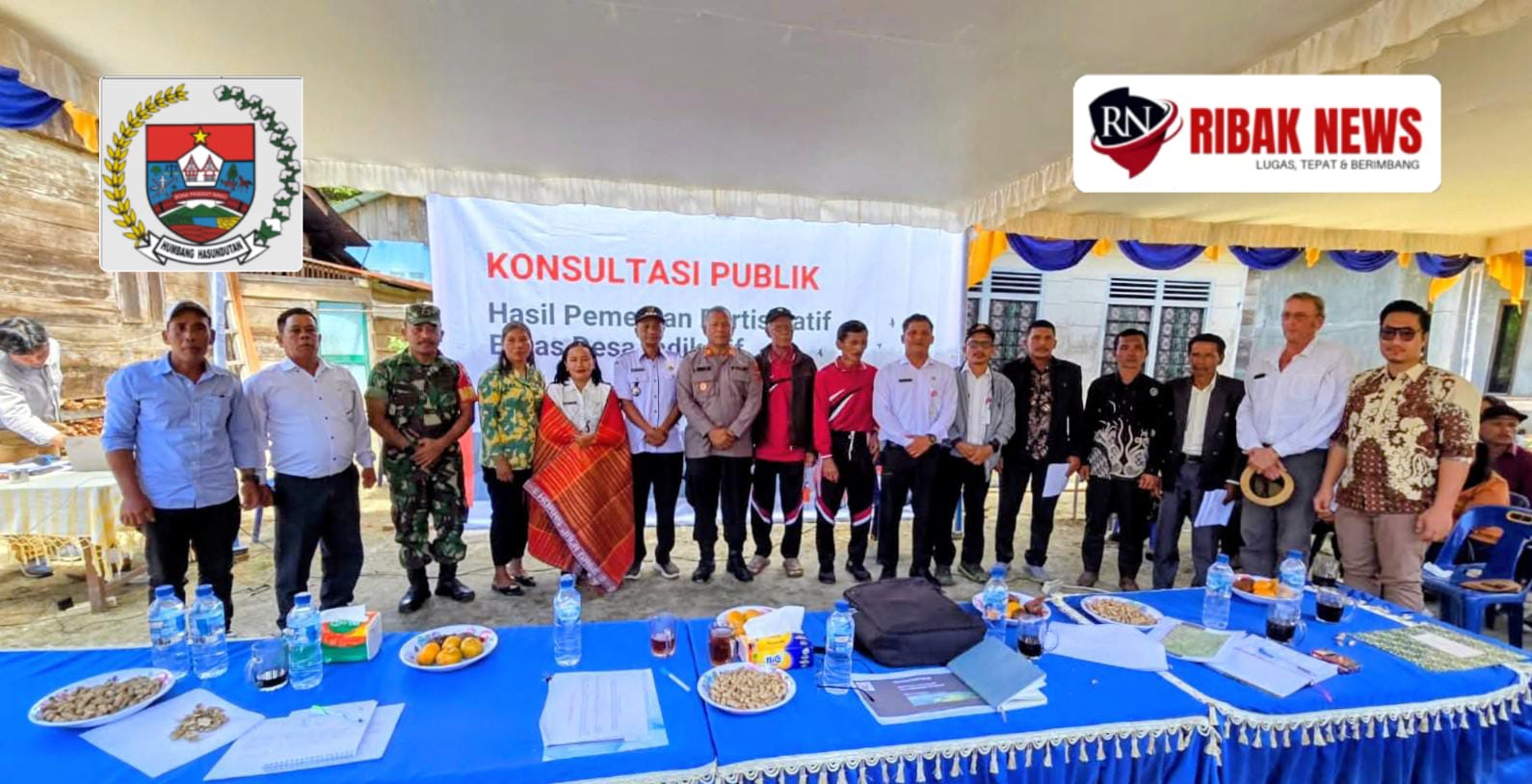
The Government of Humbang Hasundutan Regency, represented by the Office of Community Empowerment and Protection of Women and Children (PMDP2A), participated in a Public Consultation on the Participatory Indicative Village Boundary Mapping together with residents of Simataniari Village, Parlilitan Subdistrict. The consultation followed a series of mapping activities facilitated by the Tropical Forest Foundation/Earthworm Foundation, involving local communities, village officials, and security forces from the TNI–Polri.
Strengthening Legal Certainty and Good Territorial Governance
During the event, Acting Head of PMDP2A, Inrawaty K. Purba, representing Regent Dr. Oloan Paniaran Nababan, emphasized that participatory boundary mapping is an important milestone in strengthening village administrative order, improving territorial governance, and preventing boundary disputes among neighboring villages.
According to her, clarifying village boundaries is not merely drawing lines on a map. Instead, it represents legal certainty, more accurate public service delivery, and well-targeted development planning at the village level. Clear boundaries also support more efficient allocation of resources and prevent overlapping claims that could trigger prolonged conflicts.
Alignment with National Policies: One Map and Participatory Development
This consultation aligns with Presidential Instruction No. 23/2021 on accelerating the implementation of the One Map Policy, which mandates all village boundary data to be systematically recorded and synchronized. The participatory mapping conducted in Simataniari is a tangible form of community involvement—particularly village governments and local leaders—in determining territorial limits based on factual field conditions.
The process also reflects the spirit of participatory development embedded in Minister of Home Affairs Regulation No. 45/2016 on village boundary demarcation, which underscores community involvement, transparency, and consensus-building.
Reviewing Indicative Mapping Results through Open Dialogue
The public consultation served as a platform for evaluating the indicative boundary maps together with all parties involved. The government encouraged an open, objective, and inclusive dialogue, allowing village stakeholders to offer clarifications, inputs, or objections before reaching a final agreement.
The Regent, through PMDP2A, stressed that every participant should maximize the forum to ensure that decisions reflect real ground conditions and accommodate shared interests. The government aims for a final boundary agreement that is fair, transparent, and widely accepted.
Collaborative Efforts for Regional Development
In his message, Regent Dr. Oloan Paniaran Nababan expressed appreciation to all stakeholders who contributed to the participatory mapping process—particularly related government agencies, subdistrict administrations, village governments, customary leaders, and community members.
He noted that accurate territorial mapping will greatly support development planning, accelerate service delivery, and strengthen the legal foundation of village governance. The Regent also expressed hope that the joint efforts in Simataniari Village will become a positive model for other villages in Humbang Hasundutan that are preparing for similar boundary arrangements.
Ensuring Sustainable Territorial Management
The participatory indicative mapping marks a significant step toward sustainable territorial management in Simataniari Village. With the involvement of technical teams, local residents, security forces, and civil society organizations, the process not only produces accurate spatial data but also reinforces ownership and awareness within the community.
The government plans to follow up the consultation by refining the mapping results, verifying field data, and preparing the necessary administrative documents required for legal boundary recognition. This step ensures that the village boundaries will be aligned with national geospatial standards and fully integrated into the One Map system.
Conclusion
The public consultation on the participatory indicative village boundary mapping signifies a strong collaborative commitment to strengthening governance, promoting transparent spatial planning, and preventing territorial disputes. Through constructive dialogue and community involvement, the Government of Humbang Hasundutan aims to ensure that village boundaries in Simataniari are legally recognized, socially accepted, and operationally useful for future development.
Jonaer Silaban