
Friday 03 April 2026, Tapanuli Utara.
Ribakbews.id
Good Friday, observed by Christians around the world, commemorates the crucifixion and death of Yesus Kristus—a historical event that took place in Yerusalem nearly two millennia ago.
Beyond its religious significance, the event also presents a profound reflection on justice and the dynamics of power—issues that remain relevant in contemporary society.
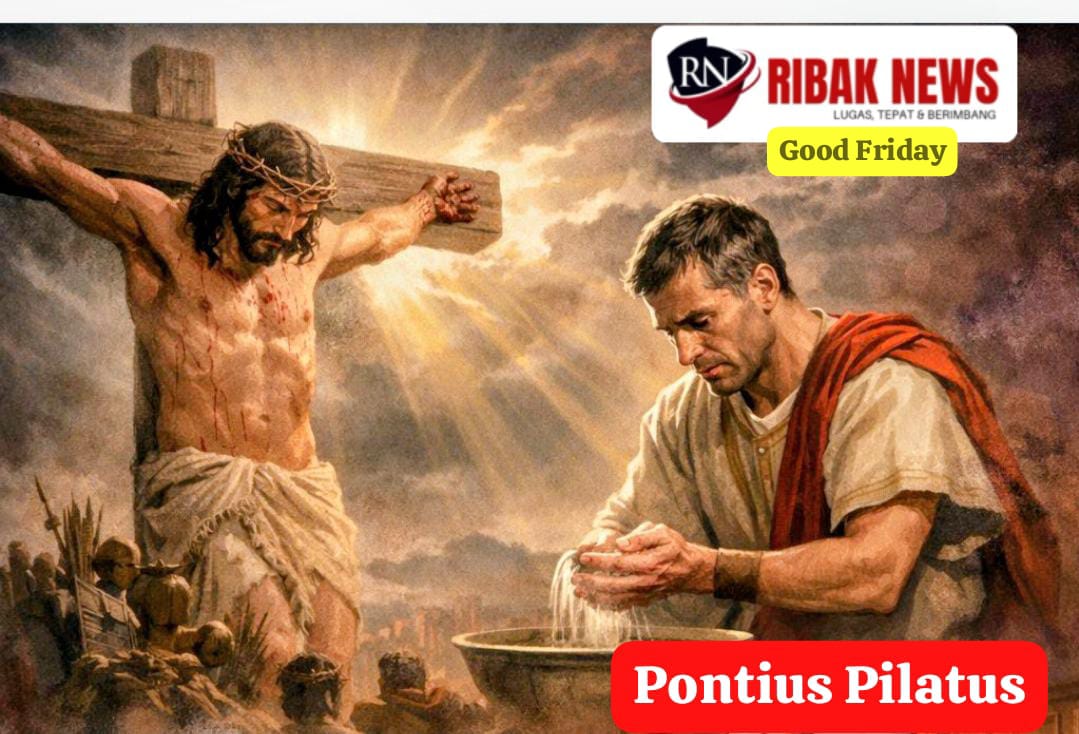
Historical accounts recorded in the New Testament describe how Yesus Kristus was arrested, tried, and ultimately sentenced to death by crucifixion under the authority of Pontius Pilatus, the Roman governor of Judea. Despite reportedly finding no sufficient legal grounds for execution, Pilate authorized the sentence following mounting pressure from the crowd.
The execution took place at Golgota, a site whose name means “the place of the skull.” At the time, crucifixion was a method of punishment commonly used by the Kekaisaran Romawi for those considered criminals or threats to authority.
Scholars and observers often point to this episode as a striking example of how justice can be influenced by social and political pressures. The decision of Pontius Pilatus has long been interpreted as a case where authority yielded to public demand rather than upholding legal integrity.
In modern contexts, similar patterns can be observed in the way public opinion—particularly in the digital age—can shape narratives and outcomes. The rapid spread of information through social media platforms has, in some cases, created environments where individuals are judged before all facts are established.
While the historical setting differs, the underlying tension between truth, power, and public perception remains a persistent theme.
Despite the tragic nature of the crucifixion, Good Friday is not solely defined by suffering. Within Christian belief, it is closely linked to Paskah, which celebrates the resurrection of Yesus Kristus. This connection frames the event as part of a larger narrative of hope, redemption, and renewal.
As such, Good Friday continues to serve not only as a religious observance but also as a moment for broader reflection on justice, responsibility, and the role of society in shaping truth.
Published by Ribak News ID
Writer/Editor